An Explainable Deep Learning Genomic Framework for Dengue Virus Serotype Classification and Phylogenetic Analysis
Abstract
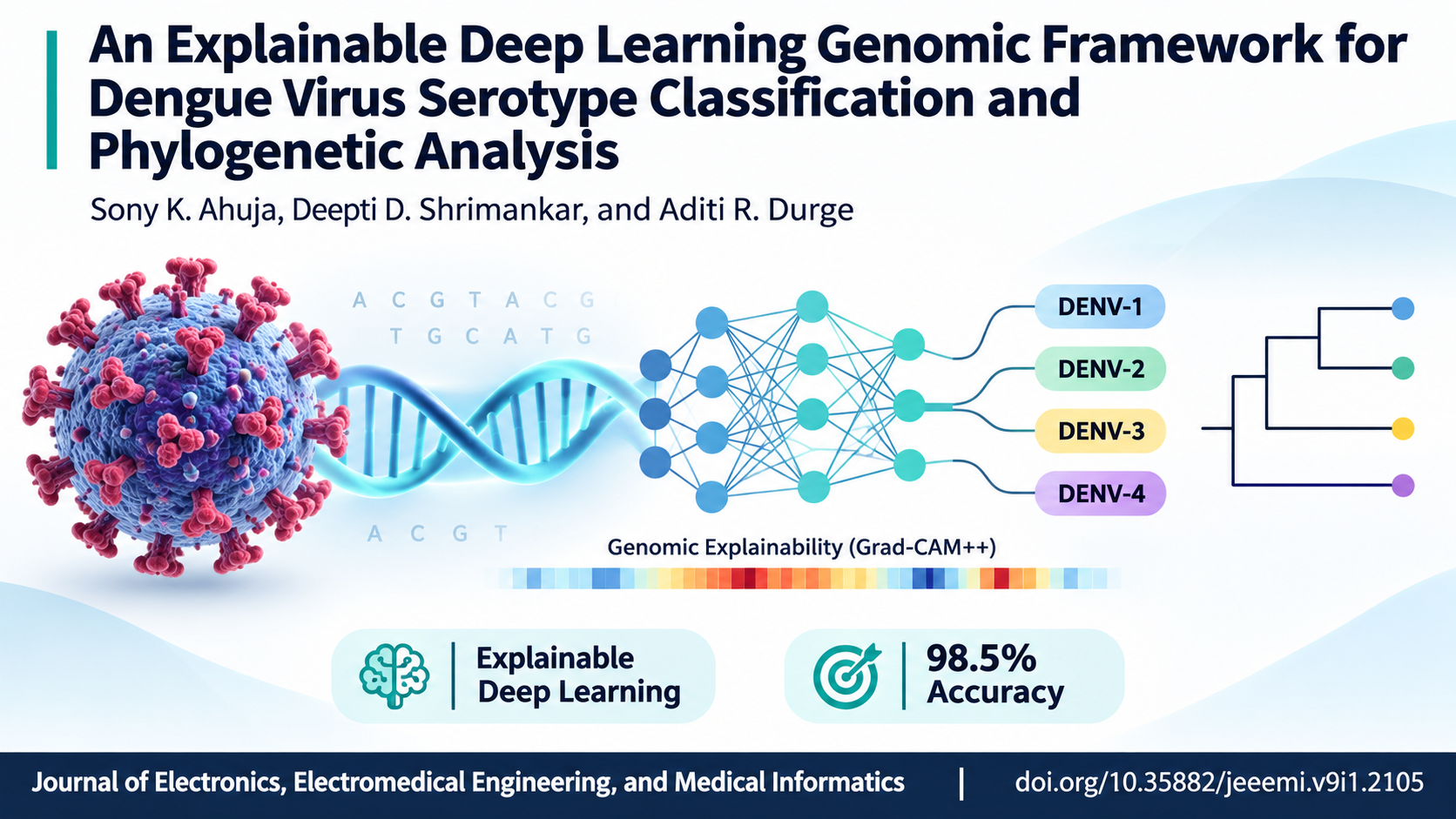
Background: Accurate dengue virus genomic surveillance requires reliable serotype identification together with evolutionary and interpretable analysis. However, existing approaches often address classification, phylogenetic analysis, or explainability independently and may not provide an integrated framework capable of jointly handling sequencing artifacts, genomic representation learning, serotype classification, evolutionary inference, and model interpretation.
Aim: Therefore, this study aims to develop a Deep Learning Hybrid Genomic Framework (DLHGF) that integrates genomic preprocessing, Transformer-based representation learning, graph-based serotype classification, phylogenetic inference, and explainable artificial intelligence within a unified analytical workflow for dengue virus genomic analysis.
Methods: The framework applies a Generative Adversarial Network-based Deep Genome Cleaner for sequence denoising, followed by MAFFT-L-INS-i multiple sequence alignment. A Genomic Transformer Encoder learns representations from overlapping 3-mer tokens. The resulting embeddings are processed using a Hierarchical Graph Neural Network integrated with a one-dimensional Convolutional Neural Network for serotype classification. An Adaptive Phylogenetic Maximum Likelihood module performs evolutionary analysis using aligned sequences, while Gradient-weighted Class Activation Mapping++ identifies genomic regions influencing classification. The framework was evaluated using 10,000 complete DENV genomes, with 2,500 sequences per serotype.
Results: DLHGF achieved 98.5% classification accuracy and an F1-score of 0.95. The phylogenetic module achieved a mean raw Robinson–Foulds distance of 0.92. The complete framework required approximately 2.4 hours for training and 0.18 seconds per sequence for inference on an NVIDIA A100 GPU.
Conclusion: DLHGF integrates serotype classification, phylogenetic inference, and model interpretability within a single dengue genomic workflow. The random-split results represent an in-distribution benchmark, while broader lineage-independent, geographic, temporal, and prospective validation remains necessary to assess generalizability.
Downloads
References
C. Davi et al., “Severe Dengue Prognosis Using Human Genome Data and Machine Learning.,” IEEE Trans. Biomed. Eng., vol. 66, no. 10, pp. 2861–2868, Oct. 2019, doi: 10.1109/TBME.2019.2897285.
S. K. Ahuja, D. D. Shrimankar, and A. R. Durge, “A Study and Analysis of Disease Identification using Genomic Sequence Processing Models: An Empirical Review,” Curr. Genomics, vol. 24, no. 4, pp. 207–235, 2023, doi: 10.2174/0113892029269523231101051455.
A. R. Durge, D. D. Shrimankar, and A. D. Sawarkar, “Heuristic Analysis of Genomic Sequence Processing Models for High Efficiency Prediction: A Statistical Perspective,” Curr. Genomics, vol. 23, no. 5, pp. 299–317, 2022, doi: 10.2174/1389202923666220927105311.
Z. Mumtaz, Z. Rashid, R. Saif, and M. Z. Yousaf, “Deep learning guided prediction modeling of dengue virus evolving serotype,” Heliyon, vol. 10, no. 11, Art. no. e32061, 2024, doi: 10.1016/j.heliyon.2024.e32061.
D. Swain et al., “Advanced multi-virus genome sequence classification using artificial intelligence techniques,” Evolutionary Bioinformatics, vol. 19, no. 3, 2025, doi: 10.1177/18724981241312343.
I. Ahmed and G. Jeon, “Enabling Artificial Intelligence for Genome Sequence Analysis of COVID-19 and Alike Viruses,” Interdiscip. Sci. – Comput. Life Sci., vol. 14, no. 2, pp. 504–519, 2022, doi: 10.1007/s12539-021-00465-0.
A. A. Rabaan et al., “Cheminformatics and machine learning approaches for repurposing anti-viral compounds against monkeypox virus thymidylate kinase,” Mol. Divers., vol. 28, no. 5, pp. 2735–2748, 2023, doi: 10.1007/s11030-023-10705-8.
M. A. Imam et al., “Machine learning, network pharmacology, and molecular dynamics reveal potent cyclopeptide inhibitors against dengue virus proteins,” Molecular Diversity, vol. 29, no. 4, pp. 2899–2917, 2025, doi: 10.1007/s11030-024-10975-w.
J. Choi et al., “Polygalic acid inhibits african swine fever virus polymerase activity: findings from machine learning and in vitro testing,” J. Comput. Aided. Mol. Des., vol. 37, no. 9, pp. 453–461, 2023, doi: 10.1007/s10822-023-00520-6.
A. Chklovski, D. H. Parks, B. J. Woodcroft, and G. W. Tyson, “CheckM2: a rapid, scalable and accurate tool for assessing microbial genome quality using machine learning,” Nat. Methods, vol. 20, no. 8, pp. 1203–1212, 2023, doi: 10.1038/s41592-023-01940-w.
A. Molinet et al., “Infectious bursal disease virus: predicting viral pathotype using machine learning models focused on early changes in total blood cell counts,” Veterinary Research, vol. 54, Art. no. 101, 2023, doi: 10.1186/s13567-023-01222-5.
E. N. Natali et al., “The dengue-specific immune response and antibody identification with machine learning,” npj Vaccines, vol. 9, Art. no. 16, 2024, doi: 10.1038/s41541-023-00788-7.
K. F. Marquart et al., “Effective genome editing with an enhanced ISDra2 TnpB system and deep learning-predicted ωRNAs,” Nature Methods, vol. 21, no. 11, pp. 2084–2093, 2024, doi: 10.1038/s41592-024-02418-z.
N. Schäfer et al., “Detection of Hepatitis C Virus Infection from Patient Sera in Cell Culture Using Semi-Automated Image Analysis,” Viruses, vol. 16, no. 12, Art. no. 1871, 2024, doi: 10.3390/v16121871.
M. Dinhobl et al., “Reclassification of ASFV into 7 Biotypes Using Unsupervised Machine Learning,” Viruses, vol. 16, no. 1, Art. no. 67, 2024, doi: 10.3390/v16010067.
B. Sahoo, S. Ali, P. Y. Chen, M. Patterson, and A. Zelikovsky, “Assessing the Resilience of Machine Learning Classification Algorithms on SARS-CoV-2 Genome Sequences Generated with Long-Read Specific Errors,” Biomolecules, vol. 13, no. 6, Art. no. 934, 2023, doi: 10.3390/biom13060934.
J. Bakkas et al., “SARSMutOnto: An Ontology for SARS-CoV-2 Lineages and Mutations,” Viruses, vol. 15, no. 2, pp. 1–14, 2023, doi: 10.3390/v15020505.
N. V. T. S. Munagala, P. K. Amanchi, K. Balasubramanian, A. Panicker, and N. Nagaraj, “Compression-Complexity Measures for Analysis and Classification of Coronaviruses,” Entropy, vol. 25, no. 1, pp. 1–12, 2023, doi: 10.3390/e25010081.
D. N. Do, G. Hu, P. Davoudi, A. Shirzadifar, G. Manafiazar, and Y. Miar, “Applying Machine Learning Algorithms for the Classification of Mink Infected with Aleutian Disease Using Different Data Sources,” Animals, vol. 12, no. 18, Art. no. 2386, 2022, doi: 10.3390/ani12182386.
Y. Li, Q. Liu, Z. Zeng, and Y. Luo, “Using an Unsupervised Clustering Model to Detect the Early Spread of SARS-CoV-2 Worldwide,” Genes, vol. 13, no. 4, Art. no. 648, 2022, doi: 10.3390/genes13040648.
A. W. D. Edridge et al., “Divergent Rhabdovirus Discovered in a Patient with New-Onset Nodding Syndrome,” Viruses, vol. 14, no. 2, Art. no. 210, 2022, doi: 10.3390/v14020210.
F. Alberts, O. Berke, L. Rocha, S. Keay, G. Maboni, and Z. Poljak, “Predicting host species susceptibility to influenza viruses and coronaviruses using genome data and machine learning: a scoping review,” Frontiers in Veterinary Science, vol. 11, Art. no. 1358028, 2024, doi: 10.3389/fvets.2024.1358028.
T. C. McCarty and I. I. Vaisman, “Respiratory Syncytial Virus Vaccine Design Using Structure-Based Machine-Learning Models,” Viruses, vol. 16, no. 6, Art. no. 821, 2024, doi: 10.3390/v16060821.
A. Zeba, A. Rajalingam, K. Sekar, and A. Ganjiwale, “Machine learning-based gene expression biomarkers to distinguish Zika and Dengue virus infections: implications for diagnosis,” VirusDisease, vol. 35, no. 3, pp. 446–461, 2024, doi: 10.1007/s13337-024-00885-8.
T. N. Chatterjee, S. Chakraborty, and R. Bandyopadhyay, “Detection of Viruses by Molecularly Imprinted Polymer Based Smart Sensors: The Current Scenario,” Sensing and Imaging, vol. 24, no. 1, Art. no. 34, 2023, doi: 10.1007/s11220-023-00431-8.
J. McBroome et al., “A framework for automated scalable designation of viral pathogen lineages from genomic data,” Nat. Microbiol., vol. 9, no. 2, pp. 550–560, 2024, doi: 10.1038/s41564-023-01587-5.
J. V. N. Josyula et al., “Metabolomic profiling of dengue infection: unraveling molecular signatures by LC-MS/MS and machine learning models,” Metabolomics, vol. 20, no. 5, Art. no. 104, 2024, doi: 10.1007/s11306-024-02169-0.
M. A. A. Khan, M. N. H. Zilani, M. Hasan, and N. Hasan, “Identification and evaluation of bioactive compounds from Azadirachta indica as potential inhibitors of DENV-2 capsid protein: An integrative study utilizing network pharmacology, molecular docking, molecular dynamics simulations, and machine learning techniques,” Heliyon, vol. 11, no. 4, Art. no. e42594, 2025, doi: 10.1016/j.heliyon.2025.e42594.
S. G. Shaikh, B. S. Kumar, G. Narang, and N. N. Pachpor, “Hybrid machine learning method for classification and recommendation of vector-borne disease,” J. Auton. Intell., vol. 7, no. 2, pp. 1–14, 2024, doi: 10.32629/jai.v7i2.797.
S. L. Tsai, J. J. Wey, S. C. Lai, Y. Q. Lin, C. J. Chang, and P. C. Huang, “Drone inspection system based on the electrochemical impedance detector by dengue NS1 biomarkers in water environments,” IEEE Sensors Lett., vol. 8, no. 9, pp. 1–4, 2024, doi: 10.1109/LSENS.2024.3449342.
F. I. Aziz, D. O. Rosales, B. F. Gudeta, and J. Uddin, “Explainable AI-Assisted Parkinson’s Disease Diagnosis Using Machine Learning and Deep Neural Networks,” Annals of Emerging Technologies in Computing, vol. 10, no. 1, pp. 45–57, 2026, doi: 10.33166/AETiC.2026.01.003.
H. Mayrose, N. Sampathila, G. Muralidhar Bairy, T. Nayak, S. Belurkar, and K. Saravu, “An Explainable Artificial Intelligence Integrated System for Automatic Detection of Dengue From Images of Blood Smears Using Transfer Learning,” IEEE Access, vol. 12, pp. 41750–41762, 2024, doi: 10.1109/ACCESS.2024.3378516.
A. Alqahtani, S. Alsubai, and M. Bhatia, “IoT-Edge-Cloud-Assisted Intelligent Framework for Controlling Dengue,” IEEE Internet Things J., vol. 11, no. 9, pp. 15682–15689, 2024, doi: 10.1109/JIOT.2023.3348101.
I. Torres, M. Nakano, J. A. Cime-Castillo, E. Escamilla-Hernandez, O. Lopez-Garcia, and H. Lanz Mendoza, “Dengue-Infected Mosquito Detection with Uncertainty Evaluation based on Monte Carlo Dropout,” IEEE Latin America Transactions, vol. 23, no. 2, pp. 135–143, 2025, doi: 10.1109/TLA.2025.10851361.
O. Saha et al., “In silico design and evaluation of multi-epitope dengue virus vaccines: a promising approach to combat global dengue burden,” Discover Applied Sciences, vol. 6, Art. no. 210, 2024, doi: 10.1007/s42452-024-05782-9.
N. Bano and A. Kumar, “Immunoinformatics study to explore dengue (DENV-1) proteome to design multi-epitope vaccine construct by using CD4+ epitopes,” Journal of Genetic Engineering and Biotechnology, vol. 21, no. 1, Art. no. 128, 2023, doi: 10.1186/s43141-023-00592-9.
L. M. de Souza et al., “Technical comparison of MinIon and Illumina technologies for genotyping Chikungunya virus in clinical samples,” Journal of Genetic Engineering and Biotechnology, vol. 21, no. 1, Art. no. 88, 2023, doi: 10.1186/s43141-023-00536-3.
H. S. Bouzidi et al., “Genomic surveillance reveals a dengue 2 virus epidemic lineage with a marked decrease in sensitivity to Mosnodenvir,” Nature Communications, vol. 15, Art. no. 8667, 2024, doi: 10.1038/s41467-024-52819-z.
K. Edenborough et al., “Dengue virus genomic surveillance in the applying Wolbachia to eliminate dengue trial reveals genotypic efficacy and disruption of focal transmission,” Scientific Reports, vol. 14, no. 1, Art. no. 28004, 2024, doi: 10.1038/s41598-024-78008-y.
J. H. K. Bonney et al., “Molecular detection of dengue virus from febrile patients in Ghana,” BMC Infectious Diseases, vol. 24, Art. no. 1382, 2024, doi: 10.1186/s12879-024-10289-0.
V. Fonseca et al., “A computational method for the identification of Dengue, Zika and Chikungunya virus species and genotypes,” PLoS Neglected Tropical Diseases, vol. 13, no. 5, Art. no. e0007231, 2019, doi: 10.1371/journal.pntd.0007231.
D. J. van Zyl, M. Dunaiski, H. Tegally, C. Baxter, and J. S. Xavier, “Craft: a machine learning approach to dengue subtyping,” Bioinformatics Advances, vol. 5, no. 1, Art. no. vbaf224, 2025, doi: 10.1093/bioadv/vbaf224.
V. Gajdov et al., “Alignment-Free Machine Learning Serotype Classification of the Dengue Virus,” Viruses, vol. 18, no. 3, Art. no. 280, 2026, doi: 10.3390/v18030280.
F. Galeone et al., “Dengue virus serotype classification from complete genomes using a Transformer with chunk-based sequence modeling and explainability analysis,” Scientific Reports, 2026, doi: 10.1038/s41598-026-69896-3.
I. J. Goodfellow, J. Pouget-Abadie, M. Mirza, B. Xu, D. Warde-Farley, S. Ozair, A. Courville, and Y. Bengio, “Generative Adversarial Nets,” in Advances in Neural Information Processing Systems 27 (NeurIPS 2014), pp. 2672–2680, 2014.
I. Gulrajani, F. Ahmed, M. Arjovsky, V. Dumoulin, and A. C. Courville, “Improved Training of Wasserstein GANs,” in Advances in Neural Information Processing Systems 30 (NeurIPS 2017), pp. 5767–5777, 2017.
K. Katoh and D. M. Standley, “MAFFT Multiple Sequence Alignment Software Version 7: Improvements in Performance and Usability,” Molecular Biology and Evolution, vol. 30, no. 4, pp. 772–780, 2013, doi: 10.1093/molbev/mst010.
A. Vaswani, N. Shazeer, N. Parmar, J. Uszkoreit, L. Jones, A. N. Gomez, Ł. Kaiser, and I. Polosukhin, “Attention Is All You Need,” in Advances in Neural Information Processing Systems 30 (NeurIPS 2017), pp. 5998–6008, 2017.
B. Q. Minh et al., “IQ-TREE 2: New Models and Efficient Methods for Phylogenetic Inference in the Genomic Era,” Molecular Biology and Evolution, vol. 37, no. 5, pp. 1530–1534, 2020, doi: 10.1093/molbev/msaa015.
I. M. Apallius de Vos, G. L. van den Boogerd, M. D. Fennema, and A. Correia, “Comparing in context: Improving cosine similarity measures with a metric tensor,” in Proceedings of the 18th International Conference on Natural Language Processing (ICON), pp. 128–138, 2021.
D. T. Hoang, O. Chernomor, A. von Haeseler, B. Q. Minh, and L. S. Vinh, “UFBoot2: Improving the Ultrafast Bootstrap Approximation,” Molecular Biology and Evolution, vol. 35, no. 2, pp. 518–522, 2018, doi: 10.1093/molbev/msx281.
Z. Yang, “Maximum-Likelihood Estimation of Phylogeny from DNA Sequences When Substitution Rates Differ over Sites,” Molecular Biology and Evolution, vol. 10, no. 6, pp. 1396–1401, 1993, doi: 10.1093/oxfordjournals.molbev.a040082.
T. N. Kipf and M. Welling, “Semi-Supervised Classification with Graph Convolutional Networks,” in Proc. International Conference on Learning Representations (ICLR), 2017.
R. Ying, J. You, C. Morris, X. Ren, W. L. Hamilton, and J. Leskovec, “Hierarchical Graph Representation Learning with Differentiable Pooling,” in Advances in Neural Information Processing Systems 31 (NeurIPS 2018), pp. 4805–4815, 2018.
S. Kiranyaz, O. Avci, O. Abdeljaber, T. Ince, M. Gabbouj, and D. J. Inman, “1D convolutional neural networks and applications: A survey,” Mechanical Systems and Signal Processing, vol. 151, Art. no. 107398, 2021, doi: 10.1016/j.ymssp.2020.107398.
A. Chattopadhyay, A. Sarkar, P. Howlader, and V. N. Balasubramanian, “Grad-CAM++: Generalized Gradient-Based Visual Explanations for Deep Convolutional Networks,” in Proc. IEEE Winter Conference on Applications of Computer Vision (WACV), 2018, pp. 839–847, doi: 10.1109/WACV.2018.00097.
T. Chai and R. R. Draxler, “Root mean square error (RMSE) or mean absolute error (MAE)? – Arguments against avoiding RMSE in the literature,” Geoscientific Model Development, vol. 7, no. 3, pp. 1247–1250, 2014, doi: 10.5194/gmd-7-1247-2014.
M. Hayati and L. Chindelevitch, “Computing the distribution of the Robinson-Foulds distance,” Comput. Biol. Chem., vol. 87, Art. no. 107284, 2020,doi:10.1016/j.compbiolchem.2020.107284.
Copyright (c) 2026 Sony Ahuja, Deepti Shrimankar, Aditi Durge

This work is licensed under a Creative Commons Attribution-ShareAlike 4.0 International License.
Authors who publish with this journal agree to the following terms:
- Authors retain copyright and grant the journal right of first publication with the work simultaneously licensed under a Creative Commons Attribution-ShareAlikel 4.0 International (CC BY-SA 4.0) that allows others to share the work with an acknowledgement of the work's authorship and initial publication in this journal.
- Authors are able to enter into separate, additional contractual arrangements for the non-exclusive distribution of the journal's published version of the work (e.g., post it to an institutional repository or publish it in a book), with an acknowledgement of its initial publication in this journal.
- Authors are permitted and encouraged to post their work online (e.g., in institutional repositories or on their website) prior to and during the submission process, as it can lead to productive exchanges, as well as earlier and greater citation of published work (See The Effect of Open Access).